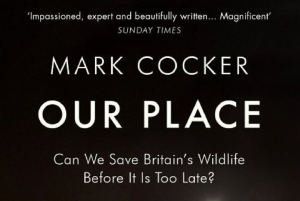
 A review of “Our Place” by Mark Cocker (ISBN 9780224102292, Jonathan Cape)
The “State of Nature” report on Britain was published in 2013. Over 3400 species were studied and it was found 60 per cent had declined in the last half century, with 31 percent declining badly. 600 were threatened with extinction. While some species have since recovered the overall trend is for further decline.
Mark Cocker wrote “Our Place” to seek to identify the causes of this environmental disaster and look at solutions. He does not avoid making all of us responsible for this. However he points the finger particularly at the capitalist and aristocratic interests that wield power over the land. In 1072, at the drawing up of the Domesday Book, 4.9 per- cent of England’s population owned 99 percent of land. Today only 25000 landowners own half of England (Guardian 17/4/19). Conservation charities own 2 percent. Scotland is even more polarised: in 2012 half the country was in the hands of 963 owners (Cocker p274). Thousands of Enclosure Acts and the Highland clearances have privatised land and dispossessed virtually the entire British population. Reasonable access to some upland and uncultivated land for recreation has only been regained with the CROW Act (2000).
This concentration of land wealth has allowed the development of agribusiness. 10 percent of farms account for half of Britain’s agricultural production (Cocker p 192). Production has been intensified and specialised so that farms produce just two or three commodities, backed up by pesticides and nitrogen fertilisers. Aided and abetted by state and EU subsidies, the variety of habitats in the countryside are reduced to monoculture. Half the ancient woodland , nearly three quarters of heathland, three quarters of ponds and almost all flower-rich meadows have gone (Cocker p211). The class interests of these owners backed by the National Farmers Union ensure that big agriculture is nicely profitable. The Ministry of Agriculture, Fisheries and Food remains enmeshed with this powerful lobby.
That lobby too has helped the massive growth in conifer forests. Tax breaks and subsidies have made this a nice little earner. This has particularly affected Scotland , with rare and vulnerable habi- tats being destroyed to make way for conifers. These forests are constructed to maximise profit and as a result do not provide a sustainable environment for many species.
Despite these damaging changes, conservation is popular. The National Trust (NT) has 5 million members, RSPB 1.2 million, and Wildlife Trusts 800,000. Cocker points to environmental battles that these organisations have taken on with varying degrees of success. But he describes the two biggest organisations as “conservative and cautious” (P42).
He is particularly scathing about the National Trust. In the 1930s a tax loophole was created for owners of big country houses whereby they could pass their proper- ties over to NT in return for not having to pay death duties and being able to live rent free in the property. In effect NT has since been run by this class and it has serviced their properties. It is hardly surprising that there is little radical environmentalism to be found at the head of such an organisation. Environmentalist Mark Avery described the NT as “a very good part of the entertainment industry”.
The weakness in “Our Place” lies in Mark Cocker’s solutions. He argues for solidarity among environmen- tal organisations to provide more effective lobbying, and for proportional representation so that green radical groups can be heard in Parliament. But to challenge the vested interests requires more than that.
The big conservation organisations were created by upper class people who loved nature, and had the wealth and time to do something about it.
But the land has always been an issue for the rural poor and city working class too, right from Kett’s rebellion and the Diggers, up to the Kinder mass trespass and anti-fracking campaigns. Land is vital to house the population in affordable homes. It requires a rational plan to grow the food and raw materials that nature can provide without the environmental damage.
To achieve that requires the public ownership of big agribusiness and the land of the 25000 who own half of England, and the 963 who own half of Scotland. Half of the land in Wales is technically unregistered so ownership is difficult to prove, but the pattern and the solution would be the same. A public debate to consider how to build enough decent affordable housing, maintain efficiency in agricultural production, while providing the environment for the variety of nature to flourish should be part of that process.
Democratic control of our land is vital. John McDonnell has argued for common ownership of land (13/11/18). It is something we must support.
Pete Watson
The Land is Ours is a radical land rights group set up by George Monbiot and others. It opposes the big business interests of large landowners and advocates access and use of land that benefits the majority. It supports some nationalisation. It advertises land rights campaigns and produces useful educational material.